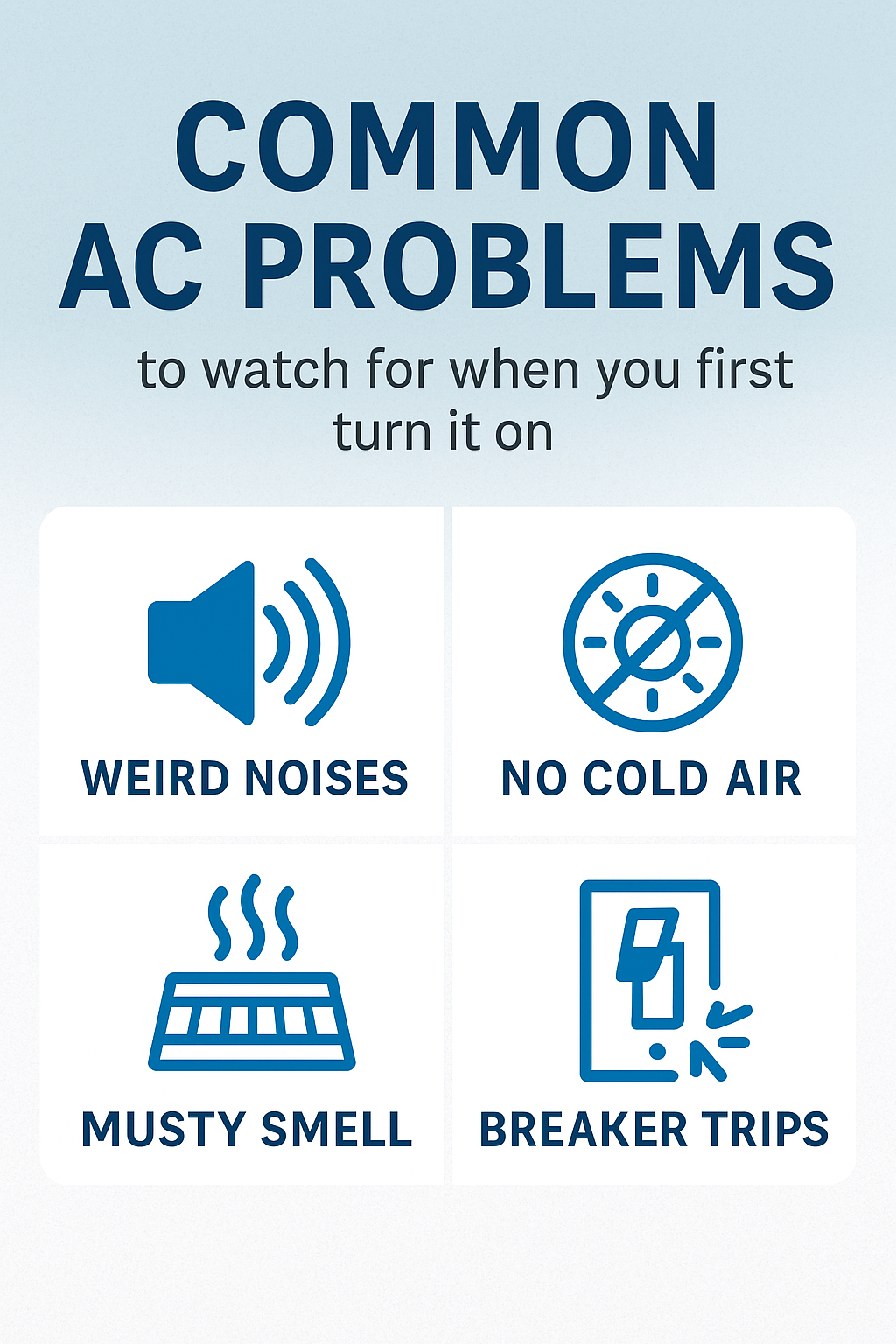
It is a scorching afternoon in Pleasanton and your AC is definitely running -- you can hear it, feel the air moving, see the thermostat blinking away. But your house is not cooling down. That is frustrating, and it is more common than you might think. This post covers the seven most common reasons an AC runs without cooling and what you can do about each one.
Check These Simple Things First
Before you call anyone, run through this short list. A surprising number of service calls trace back to something on it.
Dirty or clogged air filter. A filter caked with dust restricts the airflow the system needs to function. Pull it out and hold it up to the light. If you cannot see through it, swap it for a fresh one and give the system 30 minutes to recover.
Thermostat set to fan instead of cool. Check that the thermostat is set to COOL, not FAN. In FAN mode the blower runs but the compressor does not, so you get air movement with no actual cooling.
Tripped circuit breaker. Air conditioners draw a lot of power. If the breaker for the outdoor unit has tripped, the compressor shuts off while the indoor blower keeps running. Head to your electrical panel and check for any tripped breakers before anything else.
Closed or blocked vents. Walk your home and confirm that supply vents are open and that furniture, rugs, or curtains are not covering them. Blocked vents throw off system balance and make rooms stubbornly warm even when everything else is working.
Low Refrigerant
Refrigerant is the substance that moves heat from inside your home to the outdoors. Without enough of it, the system cannot transfer heat effectively and your house stays warm no matter how long the AC runs.
Refrigerant does not burn off or get used up on its own. If your system is low, that almost always means there is a leak somewhere in the refrigerant circuit. Adding refrigerant without finding and fixing the leak is a temporary patch at best. A licensed HVAC technician needs to locate the leak, repair it, and then recharge the system to the correct level. It is not a DIY fix and it is not something to put off, because running a system with low refrigerant accelerates wear on the compressor.
A Failing Capacitor or Contactor
The capacitor gives the compressor and fan motors the jolt they need to start up, then helps keep them running. The contactor is the electrical switch that tells the outdoor unit to turn on when your thermostat calls for cooling. Both components take a beating during summer heat, and both have a finite lifespan.
When a capacitor weakens, the compressor may struggle to start or may cycle on and off unpredictably. A bad contactor can prevent the outdoor unit from engaging at all. The good news is that a technician can test these components quickly during a standard AC service call. Replacement is usually straightforward and not a reason to replace the whole system.
Frozen Evaporator Coil
Yes, your AC can literally freeze on a 100-degree day in Danville or Dublin. The evaporator coil inside your air handler absorbs heat from the air passing over it. If that airflow is restricted, or if refrigerant levels are low, the coil can drop below freezing and ice over.
When the coil is frozen, it cannot absorb heat and the system effectively stops cooling. You may notice ice forming on the lines near your indoor unit, or you might see water pooling on the floor as ice melts. If you suspect a frozen coil, turn the system off and let it thaw completely before restarting. Running a frozen system risks damaging the compressor. Once it has thawed, check the air filter and start from the top of this list to find the underlying cause.
Dirty Condenser Coils
Your outdoor unit works by releasing the heat it pulled from your home into the outside air. The condenser coils are what make that heat transfer happen. When they are coated in dirt, grass clippings, cottonwood fluff, or debris, the unit cannot shed heat efficiently.
The result is that your system works harder, runs longer, and still cannot get your home to the set temperature. This is one of the clearest arguments for annual HVAC maintenance. A technician cleaning the condenser coils each spring takes maybe 10 minutes and can make a meaningful difference in how well your system performs through a Tri-Valley summer.
Ductwork Leaks
Your AC could be cooling perfectly well, and you would never know it, because the conditioned air is escaping into your attic or crawl space before it ever reaches the living area. Leaky ductwork is common in older homes throughout the Tri-Valley, including Livermore and San Ramon, where original duct systems have had years to shift, separate, and develop gaps at seams and connections.
Significant duct leakage can account for a substantial portion of cooling loss, meaning your system has to work much harder to compensate. A technician can perform a duct pressure test to measure how much air is escaping and pinpoint where the leaks are. Sealing ducts is one of the highest-return fixes you can make to an older home.
Compressor Problems
The compressor is the heart of your cooling system. It pressurizes the refrigerant and drives the entire heat-transfer cycle. When the compressor begins to fail, the system may run -- fan and all -- but cannot move refrigerant effectively, so no real cooling happens.
Compressor failure is a more serious diagnosis than the others on this list. On a newer system it may be worth repairing. On a system that is 10 to 12 years old or older, a failing compressor often leads to a conversation about whether repair or replacement makes more financial sense. There is no single right answer, and any honest HVAC company will walk you through the numbers for your specific situation rather than push you toward the most expensive option by default.
When to Call a Technician
If you have worked through the simple checks at the top of this list and your home is still not cooling, it is time to call a pro. Most of the issues here are not things you can diagnose or repair safely on your own, and running a malfunctioning system is not a neutral act. Continued operation can turn a manageable repair into a compressor replacement.
Call sooner rather than later if you notice ice on any part of the system, hear unusual sounds, smell something burning, or see water where it should not be. Those are signs to shut the system off and get someone out to look at it.
